Enhancing Visual Communication with Database Icons: A Designer’s Guide
Visual communication plays a pivotal role in how information is perceived and understood across various platforms. In this context, database icons have emerged as powerful tools that simplify complex concepts and enhance user experience. These icons are not just decorative elements; they serve functional purposes across websites, presentations, and printed materials. Whether you're a web developer, a graphic designer, or a marketing professional, integrating well-designed database icons into your projects can significantly improve clarity and engagement.
The Role of Database Icons in Modern Design
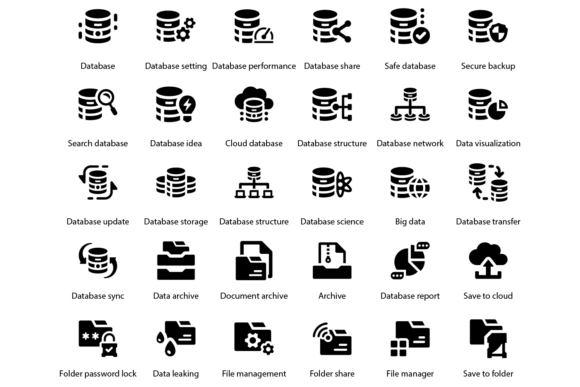
Icons have long been used to represent ideas and actions in a visually intuitive way. When it comes to data management and storage, database icons act as visual metaphors that convey the function and structure of databases without the need for lengthy explanations. These icons are especially useful in environments where space is limited, such as mobile interfaces or dashboards, where clarity and brevity are essential.
Modern design projects demand flexibility and scalability. Database icons that come in multiple formats—such as AI, EPS, SVG, and transparent PNG—allow designers to use them across a wide range of applications without compromising quality. The ability to scale vector graphics without loss of resolution ensures that these icons remain crisp and clear, whether they're displayed on a smartphone screen or a large billboard.
Practical Benefits of Using Database Icons
One of the most compelling reasons to use database icons is their adaptability. Designers can easily customize them to match brand colors, integrate them into user interfaces, or animate them for interactive experiences. This versatility makes them ideal for:
- Web and mobile application interfaces
- Data visualization tools and dashboards
- Presentations and educational materials
- Promotional and marketing collateral
- Technical documentation and infographics
Moreover, database icons help reduce cognitive load by replacing verbose descriptions with universally recognizable symbols. This is especially beneficial in multilingual environments where language barriers can hinder comprehension. A well-designed icon can transcend linguistic differences and communicate the same message across diverse audiences.
Design Considerations for Effective Icon Use
While the visual appeal of database icons is important, their effectiveness lies in their usability. A good icon should be instantly recognizable and contextually appropriate. Here are some design principles to keep in mind when selecting or customizing database icons:
- Clarity: Icons should be simple enough to be understood at a glance, especially when used in small sizes.
- Consistency: Maintain a uniform visual style across all icons to ensure a cohesive look throughout the project.
- Scalability: Vector formats like SVG and AI allow icons to be resized without losing quality, making them suitable for responsive designs.
- Accessibility: Ensure that icons are distinguishable for users with visual impairments, possibly by adding text labels or using high-contrast colors.
Designers should also consider the cultural context of their audience. Symbols that are widely understood in one region may have different meanings elsewhere. Testing icons with real users can provide valuable insights into their effectiveness and relevance.
Use Cases Across Different Industries
Database icons are not limited to software or tech-related fields. Their utility extends to various industries, including education, healthcare, finance, and retail. Here are a few examples of how different sectors can benefit from incorporating these icons:
- Educational Platforms: Used to represent data storage, user profiles, or course modules in online learning systems.
- Healthcare Applications: Icons can indicate patient records, medical databases, or secure data transmission in health information systems.
- Financial Services: Represent transaction logs, account databases, or analytics dashboards in banking and investment apps.
- Retail and E-commerce: Help visualize inventory management systems, customer databases, and order tracking interfaces.
These icons also play a crucial role in data visualization. In reports and infographics, they can be used to highlight key metrics or represent different data categories in a visually engaging way. For instance, a database icon might be used alongside charts to indicate the source of the data being presented.
Choosing the Right Format for Your Project
When selecting database icons, it's important to consider the format that best suits your design needs. Each format has its own strengths:
- SVG (Scalable Vector Graphics): Ideal for responsive web design due to their scalability and compatibility with modern browsers.
- AI (Adobe Illustrator): Best for professional designers who need to edit and manipulate vector graphics in detail.
- EPS (Encapsulated PostScript): Suitable for high-quality print materials and legacy design software.
- PNG (Portable Network Graphics): Perfect for web use where transparency and high resolution are required, especially at 256×256 pixels.
Using a combination of these formats allows for maximum flexibility. For example, a designer might use SVG for a website and PNG for a presentation slide, ensuring consistency across different mediums while maintaining visual fidelity.
Integrating Icons into User Interfaces
In web and mobile applications, database icons are often used to represent actions or features related to data storage, retrieval, and management. They can be found in navigation menus, toolbars, and status indicators. When integrating these icons into UI design, it's important to follow best practices:
- Align with User Expectations: Use icons that users are already familiar with to reduce the learning curve.
- Group Related Icons: Organize icons by function to improve usability and navigation.
- Test for Usability: Conduct user testing to ensure that the icons are intuitive and do not cause confusion.
Additionally, incorporating micro-interactions—such as hover effects or subtle animations—can make icons more engaging and enhance the overall user experience. For example, a database icon might pulse gently when new data is available, drawing attention to an update without being intrusive.
Conclusion
Database icons are more than just aesthetic enhancements; they are essential components of modern design that improve communication, usability, and user engagement. Whether you're developing a website, creating a presentation, or designing an infographic, these icons offer a versatile and effective way to convey complex information visually. With the availability of fully editable AI and EPS files, scalable SVG options, and high-resolution PNGs, designers have the tools they need to bring their creative visions to life while maintaining technical precision.