Exploring the Role of Palm Recognition in Modern Authentication Design
In today's digital-first world, biometric authentication has become a cornerstone of secure and seamless user experiences. Among the various biometric modalities, palm recognition stands out for its balance of accuracy, accessibility, and user-friendliness. As a visual element, the palm recognition icon has also gained prominence in web design, templates, and infographics, symbolizing security, identity verification, and next-generation access control.
Understanding Palm Recognition Technology
Palm recognition refers to a biometric identification method that analyzes the unique physical characteristics of a person's palm, such as ridges, valleys, and crease patterns. Unlike fingerprint scanning, which focuses on a small area, palm recognition captures a broader surface area, offering more data points for identification. This makes it a robust option for applications where high accuracy and low error rates are critical.
Modern palm recognition systems typically use near-infrared imaging or 3D depth sensing to map the palm's geometry and vein patterns. These features are difficult to replicate, making the technology resistant to spoofing and tampering. The non-invasive nature of palm scanning also contributes to its growing adoption in both public and private sectors.
The Palm Recognition Icon in Digital Design
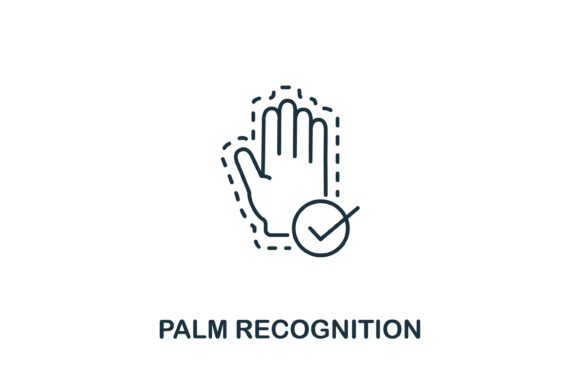
As palm recognition gains traction, its visual representation—the palm recognition icon—has become a widely used symbol in authentication design. Whether in mobile apps, website login interfaces, or data security dashboards, this icon conveys the concept of touchless, secure access. Designers often incorporate the palm recognition symbol to communicate functionality without relying on text, especially in multilingual or international contexts.
The icon is typically minimalist, featuring a stylized palm outline with subtle internal lines or biometric markers. It is often part of a larger authentication collection that includes fingerprints, facial recognition, and iris scan symbols. Designers appreciate its clean aesthetic and scalability, especially when working with vector formats like EPS or PNG that allow for easy customization.
Designing with the Palm Recognition Symbol
- Scalability: Vector-based palm recognition icons maintain clarity at any size, making them ideal for both mobile interfaces and large-format infographics.
- Consistency: When used alongside other biometric icons, it helps create a cohesive visual language for authentication features.
- Contextual Clarity: The palm icon is instantly recognizable, reducing cognitive load for users navigating login or verification steps.
Designers working on templates or UI kits often include multiple versions of the palm recognition icon—line art, filled, flat, or gradient—ensuring flexibility across themes and color schemes. For instance, a simple line element palm recognition symbol may be preferred for minimalist dashboards, while a more detailed version could be used in educational infographics explaining biometric security.
Applications of Palm Recognition in Real-World Scenarios
While the palm recognition icon serves a visual function, the underlying technology powers a wide range of practical applications. Here are some notable use cases across industries:
- Healthcare: Hospitals use palm recognition for secure access to patient records and restricted areas, ensuring only authorized personnel can enter sensitive zones.
- Finance: Banks and fintech companies integrate palm scanning into mobile and in-branch authentication systems to prevent fraud and enhance user trust.
- Education: Schools and universities implement palm recognition for attendance tracking and secure access to digital resources.
- Smart Homes and Offices: Access control systems in modern buildings increasingly use palm scans to replace traditional keys or access cards.
- Retail: Some stores are experimenting with palm-based payment systems that allow customers to check out without a wallet or phone.
These applications highlight how palm recognition not only improves security but also streamlines user experiences by eliminating passwords, PINs, or physical tokens.
Advantages of Palm Recognition Over Other Biometrics
Compared to other biometric methods, palm recognition offers several distinct benefits:
- Contactless Interaction: Unlike fingerprint scanners, palm recognition systems can work at a distance, reducing hygiene concerns and wear on hardware.
- High Accuracy: With more surface area to analyze, palm recognition can achieve lower false acceptance and rejection rates than some other modalities.
- User Acceptance: Many users find palm scanning less intrusive than facial recognition or iris scanning, which can feel more invasive.
- Compatibility: It integrates well with multimodal systems, allowing for layered security without compromising convenience.
These advantages make palm recognition a compelling choice for organizations looking to implement frictionless yet secure access control.
Implementing Palm Recognition in Your Projects
For developers and designers integrating palm recognition into applications or platforms, there are several considerations to keep in mind:
- Hardware Requirements: Ensure compatibility with the necessary imaging or sensor technology, whether built-in or external.
- Privacy Compliance: Follow data protection regulations such as GDPR or CCPA when collecting and storing biometric data.
- User Onboarding: Provide clear guidance on how to position the hand and what to expect during the scanning process.
- Visual Consistency: Use the palm recognition icon consistently across the interface to reinforce the authentication method visually.
When designing for accessibility, consider how users with disabilities or limited mobility might interact with a palm scanning system. Offering alternative authentication methods ensures inclusivity without compromising security.
Where to Get Palm Recognition Graphics
Designers seeking to incorporate the palm recognition symbol into their work can find a variety of high-quality graphic assets, including:
- EPS Files: Ideal for vector-based editing in Adobe Illustrator and other design software.
- JPG Files: Suitable for quick placement in presentations, websites, or printed materials.
- SVG Files: Great for responsive web design and scalable icons across devices.
These assets are often part of larger authentication collections, making it easy to maintain a unified visual style across different biometric features. Many design marketplaces and asset libraries offer royalty-free or subscription-based access to these graphics, often with multiple color variations and line weights.
Looking Ahead: Trends in Palm Recognition
As biometric technology continues to evolve, palm recognition is poised for broader adoption. Advances in AI and machine learning are improving the speed and accuracy of palm scan systems, while decreasing hardware costs are making them more accessible to small and mid-sized organizations.
We’re also seeing increased interest in using palm recognition for hybrid authentication scenarios—such as pairing it with voice or facial recognition—to create layered security without sacrificing user experience. In the future, palm recognition could become as ubiquitous as fingerprint scanning is today, embedded in everything from smart locks to wearable devices.
For designers and developers, staying informed about these trends ensures that their work remains relevant and aligned with user expectations. Incorporating the palm recognition icon thoughtfully into interfaces and educational materials will continue to play a role in guiding users through increasingly sophisticated authentication landscapes.